
Missing the Forest for the Tree: Why Vision Therapy Is More Than Eye Exercises
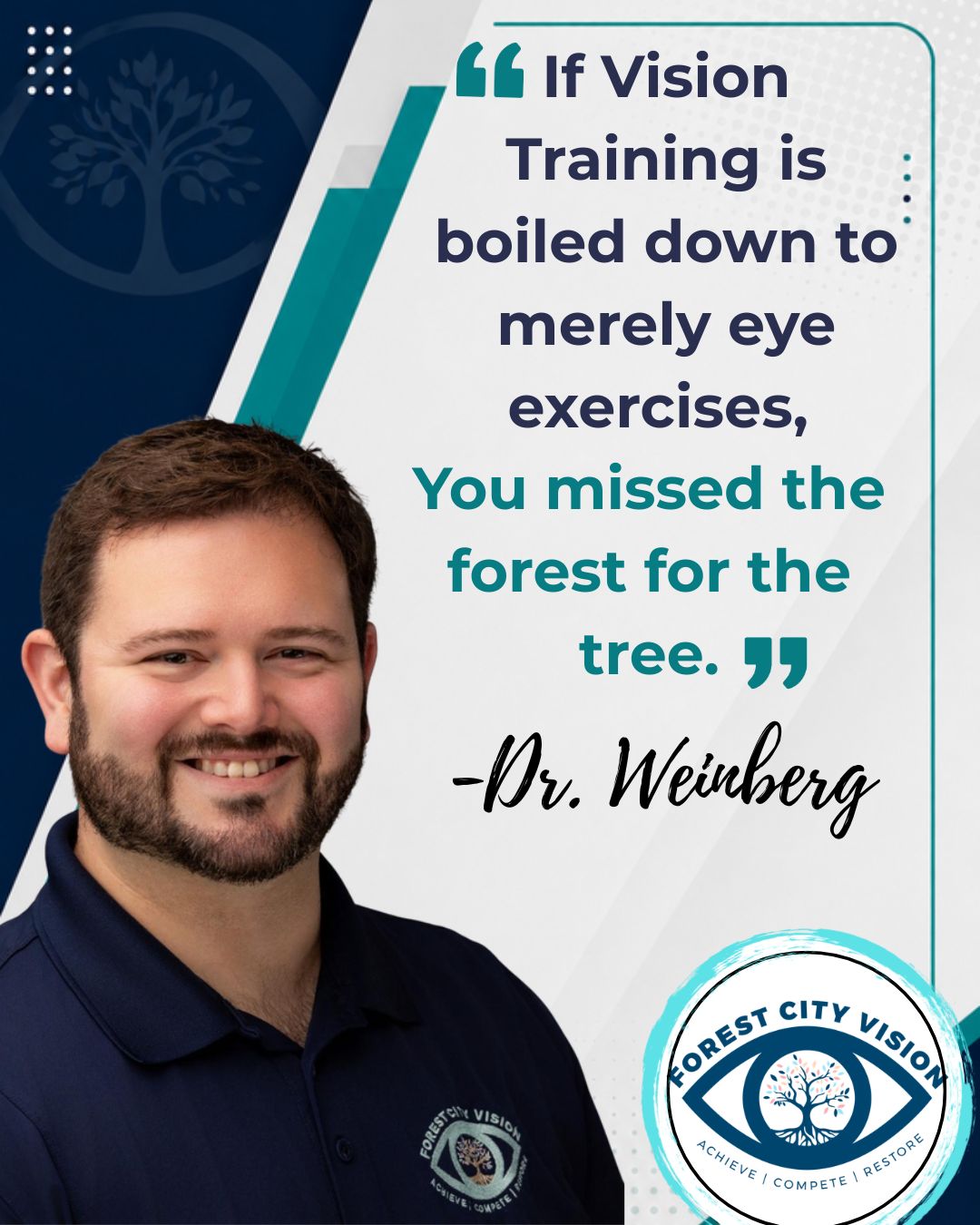
"If vision training is boiled down to merely eye exercises, you have missed the forest for the tree."
I often hear patients tell me:
"I've already done vision training."
Sometimes it was with a physical therapist. Sometimes an occupational therapist. Sometimes a chiropractor. Frequently they'll point to a Brock String hanging in an office and explain that they spent time doing convergence exercises.
The assumption is understandable. If someone is using a Brock String, Hart Chart, balance board, or tracking activity, it must be vision therapy, right?
Not necessarily.
The truth is that vision therapy is not defined by the equipment being used. It is defined by what the brain is learning while the equipment is being used.
A Brock String is just a piece of string with beads on it.
A balance board is just a board.
A lens is just a lens.
The real question is:
What is happening inside the patient's visual system while they are performing the activity?
Because that is where the therapy occurs.
The Difference Between Doing and Learning
Many approaches focus on improving a single isolated skill.
Can the eyes converge?
Can the patient track a target?
Can they follow a moving object?
Can they balance while looking at a visual target?
These skills certainly matter.
However, developmental optometry asks a different question:
How is the visual system organizing itself while the task is being performed?
What is the patient aware of?
Are both eyes contributing equally?
Is one eye being suppressed?
Are they maintaining peripheral awareness?
Can they accurately judge space?
Are they aware of how their body is positioned?
Can they maintain attention while processing visual information?
What happens when the task becomes more complex?
These are often the pieces that determine whether visual skills transfer into reading, learning, sports performance, or everyday life.
Seeing Beyond the Exercise
Consider a patient performing a Brock String activity.
To an observer, it may appear successful.
The patient is looking at the bead.
The eyes appear aligned.
The exercise is completed.
But when we evaluate more closely, we may discover:
One eye is suppressing intermittently.
A small vertical deviation is present.
Peripheral awareness disappears during the task.
The patient is unaware of body posture and spatial orientation.
Attention collapses as visual demand increases.
In other words, the patient completed the activity without actually developing the visual abilities we were hoping to improve.
The exercise was performed.
The learning never occurred.
This is why two people can perform the exact same activity and achieve completely different outcomes.
The activity itself is only the vehicle.
The adaptation of the visual system is the destination.
Awareness Is Often the Missing Ingredient
One of the most overlooked aspects of vision therapy is awareness.
What does the patient notice?
What changes when they alter their posture?
What happens to the image when they shift attention?
Can they appreciate what both eyes are contributing?
Can they recognize when visual effort increases?
Can they maintain awareness of the room around them while simultaneously completing the task?
These questions matter because vision does not happen in isolation.
We do not function in life by staring at a bead on a string.
We read while processing information.
We play sports while tracking teammates, opponents, and the environment.
We walk through the world while integrating vision, balance, movement, attention, and cognition.
Therapy should reflect that reality.
Why Patients Often See Greater Progress in Vision Therapy
This is one reason many patients arrive at our office after having performed vision-related exercises elsewhere yet continue to struggle with symptoms.
The issue is rarely a lack of effort.
Often, the missing piece is the intentional process of evaluating, measuring, guiding, and integrating visual function within a structured developmental framework.
When therapy addresses suppression, eye alignment, spatial awareness, visual processing, attention, movement, and sensory integration together, patients frequently experience breakthroughs that isolated exercises never produced.
Not because the tools are different.
Because the learning is different.
The Bigger Picture
The goal of vision therapy has never been to master a Brock String, complete a tracking chart, or perform eye exercises perfectly.
The goal is to build a visual system that works more efficiently in the real world.
A child who reads with greater ease.
An athlete who processes the game faster.
A patient recovering from a concussion who can tolerate busy environments again.
An adult who no longer experiences double vision or visual fatigue.
The activities are important.
But they are only part of the story.
When vision training becomes reduced to a collection of eye exercises, we risk focusing on the tree while missing the entire forest.
And in developmental optometry, the forest is where meaningful change happens.


