
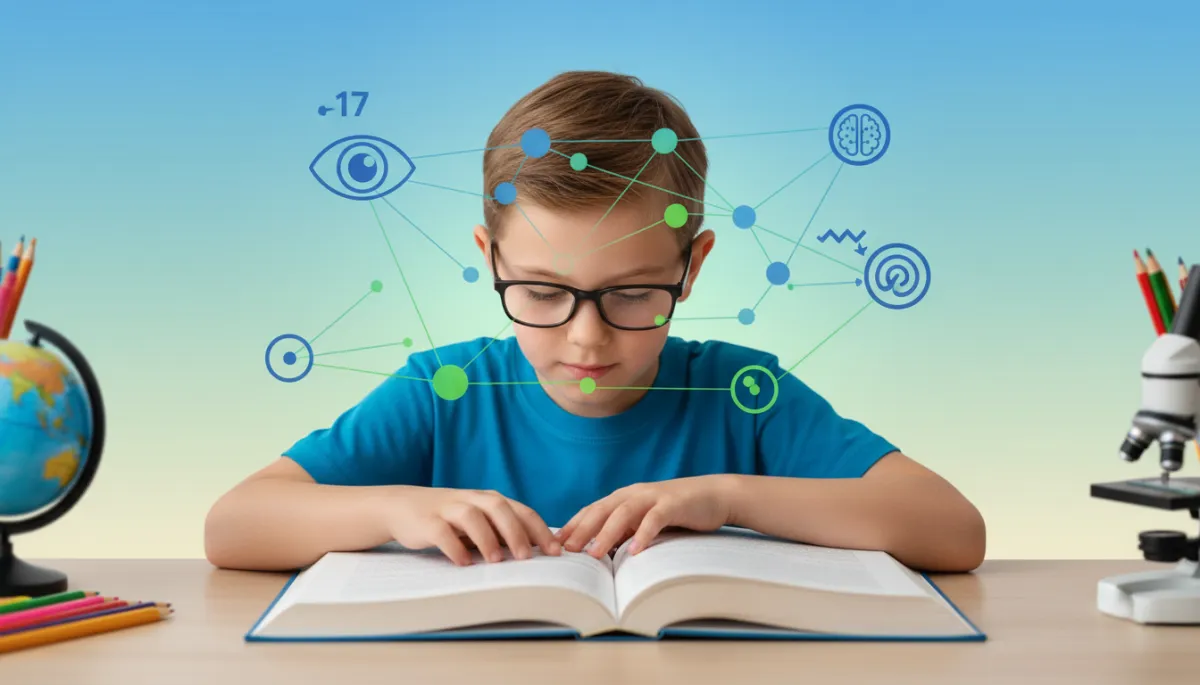
Back-to-School Eye Exams: 17 Visual Skills Matter
Back to School, Children’s Vision, Learning
Back-to-School Eye Exams: Why All 17 Visual Skills Matter for Reading and Learning
As kids head back to school, most parents think of new backpacks, sharpened pencils, and maybe a quick vision screening. But many learning struggles start with vision problems that a basic “20/20” test will never catch. To truly support reading and classroom success, children need in-depth testing of all 17 visual skills required for learning.
Vision Is More Than Seeing the Board Clearly
When schools or pediatric offices do quick vision checks, they usually test one thing: how clearly your child can see letters on a chart at a distance. That’s visual acuity, and it’s important—but it’s only one piece of a much bigger puzzle. Reading, writing, copying from the board, and staying focused in class depend on a complex team of visual skills all working together smoothly.
📌 Key Takeaway: A “perfect” 20/20 score doesn’t rule out hidden vision problems that can quietly derail learning and attention in the classroom.
A child can pass a school screening, be told they have “perfect vision,” and still struggle with headaches, skipping lines, slow reading, or avoiding homework. Often, the root cause is a hidden problem with one or more of the 17 visual skills that support learning. That’s why comprehensive back-to-school eye exams—like those offered by behavioral and developmental optometrists and vision therapy practices—are so essential.
The 17 Visual Skills Every Student Needs
Below are the 17 key visual skills that should be evaluated in an in-depth back-to-school eye exam. Together, they form the foundation for comfortable, efficient reading and learning.
1. Distance Visual Acuity
This is the familiar “20/20” measure—how clearly your child sees the board or screen across the room. Blurry distance vision can cause squinting, leaning forward, or missing important details from the teacher’s presentation. It’s crucial, but it’s only the starting point of a thorough exam.
2. Near Visual Acuity
Children spend much of their school day working up close—reading books, filling out worksheets, and using tablets or laptops. Near visual acuity measures how clearly they can see at reading distance. A child might see the board well but struggle to see print on the page, leading to fatigue and avoidance of close work.
3. Eye Teaming (Binocular Coordination)
Eye teaming is the ability of both eyes to work together as a coordinated pair. If the eyes don’t aim at the same point in space, words can appear to move, double, or blur. Children with poor eye teaming may lose their place, reread lines, or complain that “the words are dancing on the page,” even though they may not be able to explain exactly what they see.
4. Convergence (Turning the Eyes Inward Up Close)
Convergence is a specific eye teaming skill: the ability to turn both eyes inward to look at a near object, like a book. If convergence is weak (a condition often called convergence insufficiency), reading can cause eye strain, headaches, or blurry and double vision. Kids may push the book farther away, cover one eye, or avoid reading altogether to feel more comfortable.
5. Divergence (Turning the Eyes Outward for Distance)
Divergence is the ability to relax the eyes outward to look at distant objects, such as the board or a teacher across the room. Problems with divergence can make it hard to shift focus from a book to the board and back again. Children may lose track of where the class is or struggle to copy notes accurately and efficiently.
6. Focusing (Accommodation)
Focusing skills allow the eyes to adjust to see clearly at different distances. Good focusing means your child can maintain clear vision up close and quickly shift focus from near to far and back again. If focusing is weak, print may blur after a few minutes, and switching between the board and desk work can be slow and tiring, often mistaken for inattention or lack of effort.
7. Focusing Flexibility (Accommodation Facility)
Focusing flexibility is how easily the eyes can change focus back and forth between different distances. In the classroom, this happens constantly: looking up to the teacher, down to the notebook, and back to a device. Poor flexibility can cause temporary blur, slower copying, and frustration with multi-step directions that involve both listening and reading.
8. Saccades (Quick Eye Jumps)
Saccades are the rapid eye movements that allow us to jump from word to word and line to line while reading. Efficient saccades help a child read smoothly without losing their place. When this skill is weak, kids may use a finger to track, skip words or entire lines, or read the same line twice, which slows comprehension and makes reading feel like hard work.
9. Pursuits (Smooth Tracking)
Pursuits are the smooth eye movements used to follow a moving object, such as a ball, a pointer on the board, or scrolling text on a screen. Strong pursuit skills support sports, handwriting, and visual attention. Difficulties here can show up as clumsiness in games, trouble copying from the board, or losing track when text moves or when the teacher points quickly to different areas of the room or screen.
10. Depth Perception (Stereopsis)
Depth perception is the ability to judge how far away objects are and how they relate to one another in space. It depends on both eyes working together. In school, depth perception helps with catching a ball in gym, navigating stairs, and accurately placing a pencil on paper. Weak depth perception may make a child appear uncoordinated or hesitant in new environments, which can affect confidence and participation.
11. Peripheral Vision (Side Vision Awareness)
Peripheral vision is the awareness of what’s happening to the sides while the eyes are focused straight ahead. In the classroom, good side vision helps a child stay oriented on the page, notice where lines start and end, and remain aware of the environment without constantly looking around. Reduced peripheral awareness can contribute to losing place when reading or feeling overwhelmed in busy settings like hallways and playgrounds.

Tracking and eye teaming tests reveal hidden issues that simple 20/20 screenings miss.
12. Color Perception
Color perception is the ability to distinguish and correctly identify different colors. While color vision issues are less common, they can affect how a child interprets graphs, charts, color-coded instructions, and classroom materials. Early identification allows teachers and parents to adapt materials so the child isn’t unfairly disadvantaged or mislabeled as not paying attention to details.
13. Visual Memory
Visual memory is the ability to remember what the eyes have seen and recall it later. It plays a major role in spelling, remembering sight words, and recalling diagrams or charts during tests. Children with weak visual memory may study hard but still struggle to remember how words look or how information was organized on the page, affecting both reading fluency and test performance.
14. Visual Sequential Memory
Visual sequential memory is the ability to remember the order of visual information—such as the sequence of letters in a word or numbers in a math problem. This skill is vital for decoding, spelling, and following multi-step written directions. When it’s weak, children may reverse letters, mix up word order, or have trouble remembering math facts and formulas in the correct sequence.
15. Visual Form Perception (Figure–Ground, Constancy, and Closure)
Visual form perception includes several related skills: figure–ground (finding important information in a busy background), constancy (recognizing a form even when size, font, or orientation changes), and closure (filling in missing visual information). In class, these skills help children find a word on a crowded page, recognize letters in different fonts, and quickly make sense of partially seen or messy writing on the board. Weaknesses can make worksheets, dense text, and cluttered pages feel overwhelming and confusing.
16. Visual-Spatial Skills
Visual-spatial skills involve understanding where objects are in relation to each other and to oneself. They support handwriting (keeping letters on the line), math (lining up columns, understanding place value, geometry), and reading (knowing left from right and tracking across the page). Children with visual-spatial difficulties may reverse letters or numbers, struggle with maps and graphs, or have messy, disorganized written work despite strong verbal abilities.
17. Visual Integration with Other Senses and Motor Skills
Finally, visual integration is the ability to coordinate vision with other systems, such as hand movements, balance, and auditory processing. This is essential for copying from the board, taking notes while listening, catching and throwing, and using technology effectively. When visual information doesn’t integrate smoothly with the rest of the body and brain, children may appear clumsy, disorganized, or easily overwhelmed by multi-step tasks, even though their intelligence is perfectly normal—or above average.
Why Standard Screenings Miss So Much
School screenings and many quick eye checks focus on visual acuity alone. They rarely evaluate eye teaming, tracking, focusing flexibility, or visual processing skills. As a result, children with significant visual challenges are often told their eyes are “fine,” and their struggles get blamed on motivation, attention, or behavior instead of a treatable visual problem.
💡 Pro Tip: Ask specifically whether your child’s exam will test tracking, eye teaming, and visual processing skills—not just distance and near clarity.
Comprehensive exams—like those provided by developmental optometrists and vision therapy clinics—use specialized tests to measure all 17 visual skills. When weaknesses are found, targeted treatment plans, often including vision therapy, can strengthen those skills and make reading and learning far more comfortable and efficient.
Signs Your Child May Need In-Depth Visual Testing
As you prepare for the new school year, watch for these common red flags:
Complaints of headaches, eye strain, or fatigue after reading or screen time
Skipping or repeating lines, using a finger to keep place, or losing place easily
Avoidance of reading, homework battles, or very slow reading despite good decoding skills
Reversing letters or numbers, messy handwriting, or trouble lining up math problems
Difficulty copying from the board or taking notes while listening
Clumsiness in sports or gym, poor depth judgment, or frequent bumps and spills
Make This School Year Easier with a Comprehensive Eye Exam
Back-to-school is the perfect time to go beyond a quick screening and schedule an in-depth eye exam that evaluates all 17 visual skills. Identifying and addressing visual issues early can transform your child’s experience of school—turning reading from a daily struggle into a manageable, even enjoyable, part of the day.
If your child has been labeled “distracted,” “lazy,” or “not trying hard enough,” but you sense something more is going on, a comprehensive visual evaluation can provide the missing piece. When vision works smoothly, children can finally show what they’re truly capable of—both in the classroom and beyond.
To learn more or schedule a comprehensive back-to-school eye exam, contact Dr. Zach Weinberg at Forest City Vision, where all 17 visual skills are carefully evaluated to support your child’s reading and learning success.


