The Brain-Eye Connection: What Every Parent Should Know About How Children See and Learn
The Brain-Eye Connection: What Every Parent Should Know About How Children See and Learn
When parents think about their child's vision, they often picture a standard eye chart — the kind where a child reads letters from across the room. But vision is so much more than the ability to see clearly at a distance. For children, the way their eyes and brain work together can shape how they read, focus, follow along in class, play sports, and move through the world every single day.
At Forest City Vision, we talk about the brain-eye connection often — because understanding it is one of the most important things a parent can know when it comes to their child's eye health and overall development. If your child is struggling with reading, attention, coordination, or visual comfort and their last basic eye exam came back "normal," this may be exactly why.
Vision Is a Brain Function, Not Just an Eye Function
Here is a fact that surprises many families: approximately 80% of learning happens through vision, and the vast majority of visual processing takes place in the brain — not in the eyes themselves.
Your eyes collect light and send signals. Your brain does the rest: interpreting what you see, connecting it to memory and language, coordinating both eyes to work as a team, controlling where your eyes point and how they focus, and linking visual information to movement and balance. This entire system — the eyes, the visual pathways, and the many brain regions involved in interpreting what we see — is what we mean when we talk about the brain-eye connection.
When this connection works smoothly, reading and learning feel effortless. When it doesn't, children can struggle in ways that are easy to misread as an attention problem, a learning disability, or simply not trying hard enough.
What Is Neurovision?
Neurovision — sometimes called cognitive vision — refers to the visual skills and brain-based processes that allow us to do much more than simply see. It includes how the visual system integrates with thinking, memory, coordination, and attention. When a child has strong neurovision skills, their visual system is working fluidly with the rest of their brain to support daily tasks.
Neurovision skills include things like:
- Visual attention: the ability to focus the eyes on what matters and filter out distractions
- Visual memory: retaining and recalling what has been seen
- Visual-spatial processing: understanding where things are in space relative to each other
- Visual-motor integration: connecting what the eyes see with what the hands and body do
- Processing speed: how quickly the brain makes sense of visual information
These skills are rarely tested in a standard school vision screening or basic pediatric eye exam. That's why a child can pass a vision screening and still struggle significantly in school or in activities that rely on visual skills.
Signs That the Brain-Eye Connection May Need Support
Children rarely say, "My eyes aren't working well with my brain." Instead, they show it through behavior — and those behaviors are often misunderstood. Here are some signs that a child's brain-eye connection may be affecting their daily life:
Reading and Learning
- Loses their place while reading or uses a finger to track every line
- Skips words or lines without realizing it
- Rereads the same line repeatedly
- Avoids reading or complains that the words "move" or "blur"
- Struggles with reading comprehension even though they can decode words
- Takes much longer than expected to complete written assignments
Attention and Behavior
- Seems distracted or unfocused, particularly during close-up tasks
- Becomes tired, frustrated, or irritable after short periods of reading or screen time
- Covers or closes one eye without realizing it
- Complains of headaches, especially in the afternoon or after school
Coordination and Spatial Awareness
- Difficulty with catching or hitting a ball
- Poor handwriting or difficulty keeping writing on a line
- Trouble with puzzles, mazes, or other visual-spatial tasks
- Bumping into things or misjudging distances
None of these signs, on their own, confirms a visual processing problem. But when a child is showing several of these signs — especially if they have passed a standard eye exam — it is worth exploring whether their visual skills are contributing to what their family and teachers are observing.
How the Brain and Eyes Can Fall Out of Sync
The brain-eye connection can be disrupted by several things. Some children are born with differences in how their visual system is wired. Others develop challenges over time, particularly during the high-demand years of learning to read and write. Conditions like binocular vision dysfunction (BVD) — where the two eyes have difficulty working together as a coordinated team — can place enormous strain on the visual system and the brain.
When the two eyes are not fully aligned or coordinated, the brain works overtime to compensate, often suppressing input from one eye or constantly working to merge two slightly misaligned images. Over time, this effort can contribute to symptoms like headaches, fatigue, difficulty concentrating, and reading and learning issues that may look like something other than a vision problem.
Conditions like convergence insufficiency — a common and often under-identified problem where the eyes struggle to turn inward together for near-point tasks like reading — are closely tied to the brain-eye connection. Research has linked convergence insufficiency with symptoms that overlap significantly with attention challenges, yet this condition cannot be detected on a standard distance eye chart.
How Developmental Optometry Addresses the Brain-Eye Connection
Developmental optometry is a specialty area of eye care that evaluates and treats the full visual system — including the brain-based visual skills that standard exams don't measure. A children's vision specialist trained in developmental optometry looks at how a child's eyes move, focus, team, and process information, not just whether they can see the letters on a chart.
At Forest City Vision, a comprehensive developmental vision evaluation may include assessment of:
- Eye teaming and binocular vision
- Eye tracking and smooth pursuits
- Focusing flexibility (accommodative function)
- Visual perception and processing speed
- Visual-motor integration
This kind of evaluation gives families a much more complete picture of what a child's visual system is doing — and whether it may be contributing to academic, behavioral, or coordination concerns.
Can Vision Therapy Help Strengthen the Brain-Eye Connection?
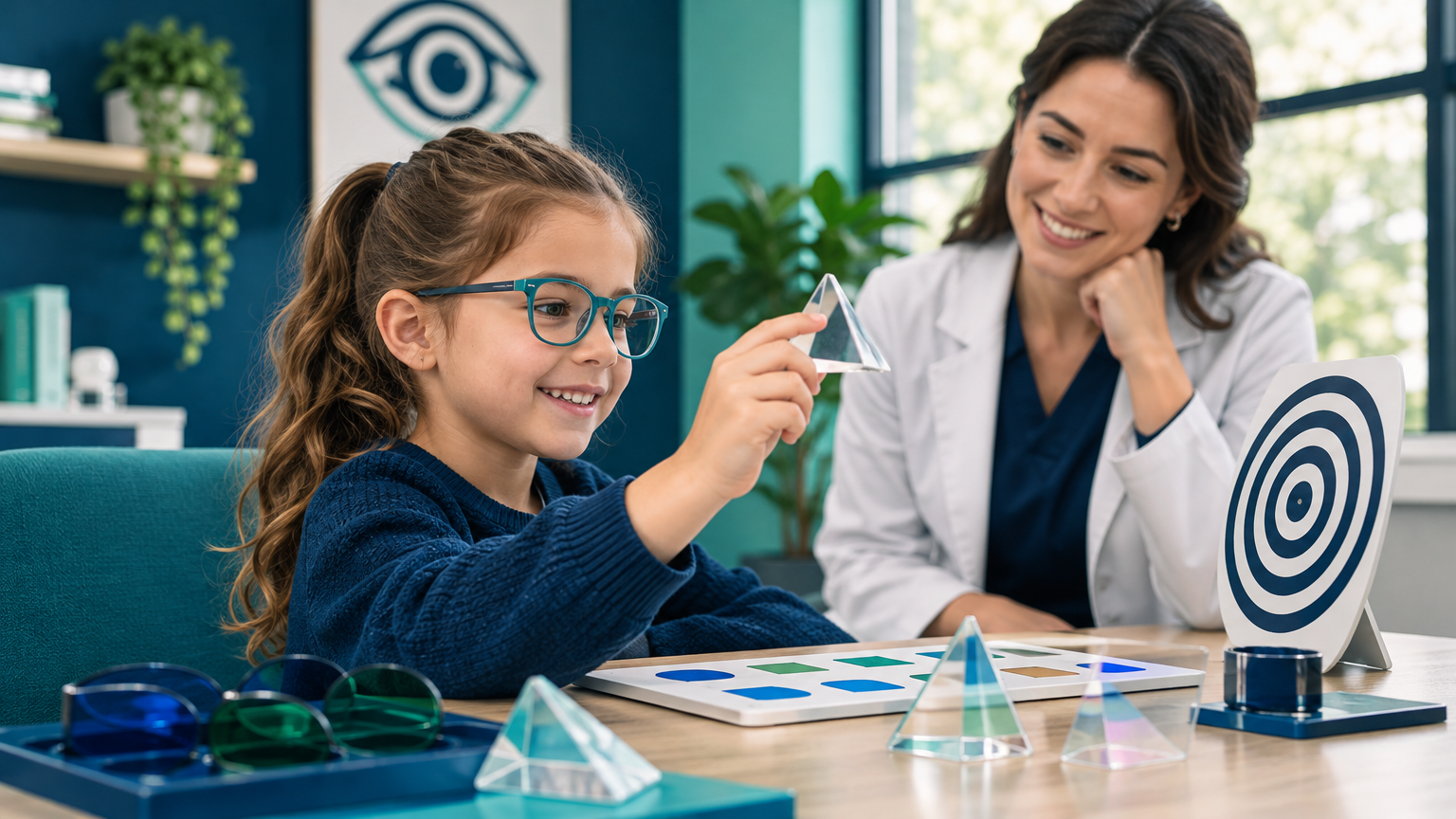
Vision therapy is a structured, individualized program of activities and exercises designed to improve how the visual system functions — including the brain-based visual skills that support reading, learning, attention, and performance. Think of it as focus training and coordination work for the eyes and brain, supervised by a developmental optometrist.
Vision therapy may help children who struggle with:
- Eye teaming problems and binocular vision dysfunction (BVD)
- Convergence insufficiency
- Visual tracking difficulties
- Visual processing and perceptual challenges
- Amblyopia (lazy eye) and strabismus (eye turn), in some cases
It's important for families to understand that vision therapy is not a cure for learning disabilities, ADHD, dyslexia, or autism. What it can do, in children who have a genuine underlying visual skill deficit, is reduce the visual burden that may be making those challenges harder to manage. A comprehensive evaluation is always the right first step — it's what tells us whether a child's visual system is contributing to what their family is seeing.
For families in northeast Ohio, Vision Therapy Cleveland at Forest City Vision offers individualized evaluations and therapy programs designed around each child's specific visual profile.
The Brain Is Adaptable — and That's Good News
One of the most hopeful things about the brain-eye connection is that the brain is remarkably adaptable, particularly in children. With the right kind of targeted, consistent practice through vision therapy, many children can build stronger visual skills over time. This neuroplasticity — the brain's ability to form new connections and patterns — is what makes early identification and intervention so meaningful.
The earlier a visual skill challenge is identified, the more opportunity there is to address it before it compounds over years of academic demands. That said, visual skills can be developed at any age, and many adults benefit from vision therapy and vision rehabilitation as well.
When to Ask for a Comprehensive Vision Evaluation
If your child has passed a standard vision screening but is still struggling with reading, learning, focus, or coordination, it may be time to request a comprehensive developmental vision evaluation. A basic screening checks distance acuity — it is not designed to assess the visual skills that support learning.
It's also worth asking for an evaluation if your child:
- Has been diagnosed with or is being evaluated for a reading or learning difficulty
- Has an IEP or receives reading support at school
- Reports frequent headaches, eye fatigue, or discomfort during near tasks
- Has a history of concussion or head injury
- Is a young athlete noticing visual performance challenges
Take the Next Step With Forest City Vision
At Forest City Vision, our team specializes in evaluating and supporting the full brain-eye connection — from pediatric vision care and developmental optometry to vision therapy and neuro-visual rehabilitation. We work with children, families, educators, and referring providers to make sure no child's visual challenge goes unrecognized.
If something in this article resonated with what you're seeing in your child, we'd love to help. A comprehensive developmental vision evaluation is a great place to start the conversation.
Contact Forest City Vision today to schedule a comprehensive evaluation — and discover what a complete picture of your child's visual health can tell you.
Disclaimer: This article is intended for educational purposes only and does not constitute medical or clinical advice. If you have concerns about your child's vision or development, please consult a qualified eye care professional for a personalized evaluation.


