
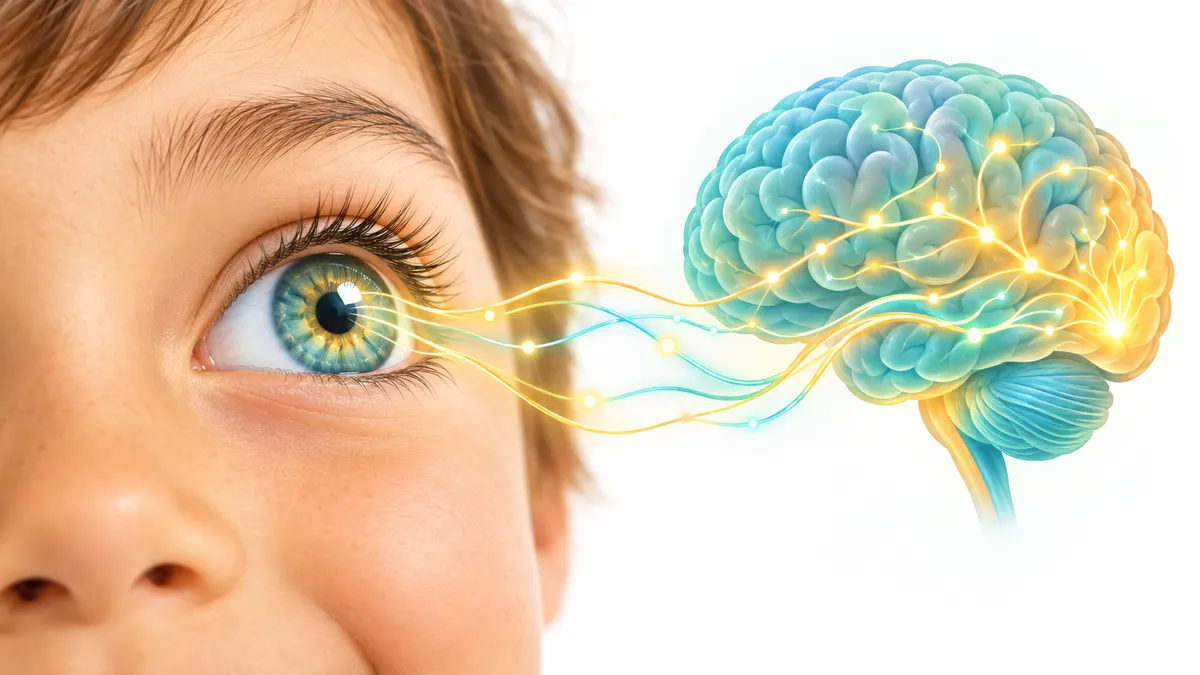
Your Child's Brain and Eyes Are Always Talking — Here's What That Means for Learning
When most people think about their child's vision, they think about the eyes themselves — whether the prescription is right, whether glasses are needed, or whether there is an obvious problem like a turned eye. But here's something that surprises many parents: roughly 80% of what the brain processes is visual information. That means the quality of the conversation happening between your child's eyes and brain every single second has a profound effect on how they read, learn, focus, and move through the world.
At Forest City Vision, we spend a lot of time talking with families about the brain-eye connection — what it is, why it matters, and what can happen when that connection isn't working as smoothly as it should. If your child is struggling with reading, seems easily distracted, avoids close work, or has been told they may have attention difficulties, understanding this relationship could be an important piece of the puzzle.
Vision Is Far More Than Eyesight
There is an important distinction that often gets overlooked: eyesight is the ability to see clearly at a distance — what an eye chart measures. Vision, on the other hand, is a complex set of learned skills that the brain develops over time, including the ability to track a moving target, team both eyes together, sustain focus, process what is seen, and connect visual information to memory and understanding.
A child can pass a standard vision screening with flying colors and still struggle with the visual skills that reading and learning demand every day. Standard screenings are designed to catch refractive problems like nearsightedness — they are not designed to evaluate how well a child's visual system performs under the sustained, coordinated demands of a school day.
This is where developmental optometry comes in. A developmental optometrist evaluates the full range of visual skills — not just clarity, but eye teaming, tracking, focusing, visual processing, and the integration of visual information with the rest of the brain.
What Is the Brain-Eye Connection?
The term brain-eye connection refers to the intricate, two-way communication pathway between the eyes and the visual cortex — and the wider network of brain regions that interpret and act on visual input. Seeing is not a passive act. When your child looks at a page of text, their brain is simultaneously:
- Coordinating both eyes to point at the same location (eye teaming)
- Making tiny, precise movements to travel across each line of text (tracking)
- Adjusting focus rapidly as the eyes shift from near to far (accommodation)
- Recognizing and decoding letters and words (visual processing)
- Connecting those symbols to language, memory, and meaning (cognitive vision)
All of this happens in fractions of a second, thousands of times throughout a school day. When any part of this system is under-developed or inefficient, the brain has to work much harder — and children often don't have the words to explain why reading feels exhausting, why their eyes hurt after homework, or why the words seem to move on the page.
Signs the Brain-Eye Connection May Need Support
Because children often cannot articulate what they are experiencing visually, parents and teachers tend to notice behavioral or academic signs first. Some of the most common signals that a child's visual skills may be contributing to difficulty include:
- Losing their place while reading or skipping lines
- Re-reading the same sentence multiple times
- Holding books unusually close or tilting the head to one side
- Complaints of headaches, eye strain, or blurry vision after reading
- Avoiding reading, homework, or other close-up tasks
- Short attention span specifically during visual tasks
- Difficulty copying from the board
- Words appearing to move, blur, or double on the page
- Trouble with handwriting, spacing, or staying on lines
- Slow reading speed despite strong comprehension when read aloud
These signs can overlap with other challenges, which is why it is important not to assume any one cause. A comprehensive developmental vision evaluation can help determine whether visual skills are a contributing factor — and that information alone can be enormously clarifying for families.
Neurovision: When the Brain Needs to Learn a New Visual Language
Neurovision is a term used to describe the branch of vision care that focuses specifically on how the brain learns, adapts, and reorganizes its visual processing — sometimes called neuroplasticity in the visual system. The good news embedded in this idea is significant: the brain can learn. Visual skills that are underdeveloped or disrupted — whether from birth, from a concussion, from a developmental difference, or from a neurological event — can often be strengthened through the right kind of targeted, structured practice.
This is the foundation of vision therapy: a program of guided visual activities, supervised by a trained optometrist, designed to build the specific skills the brain and eyes need to work together efficiently. Vision therapy is not simply doing eye exercises at home. It is a clinically supervised process that teaches the visual system new patterns — much the way physical therapy teaches injured muscles and joints to move correctly again.
How Vision Therapy Supports the Brain-Eye Connection
A personalized vision therapy program may address a range of skills depending on what a child's evaluation reveals. Common areas of focus include:
- Convergence insufficiency — a common condition in which the eyes struggle to work together at near distances, making reading physically effortful and uncomfortable
- Binocular vision dysfunction (BVD) — a broader category of eye teaming problems that can cause visual fatigue, headaches, and difficulty with sustained focus
- Tracking — smooth, accurate eye movements across a line of text or a moving target
- Accommodation — the ability to shift focus quickly and maintain clear vision at varying distances
- Visual processing — how the brain interprets, remembers, and makes sense of what the eyes take in
Children who complete a program of vision therapy often show meaningful improvement in reading comfort and stamina, attention during near tasks, and confidence in the classroom. Parents frequently report that their child seems less frustrated, more willing to read independently, and better able to sustain focus on schoolwork. These are not guaranteed outcomes — every child's visual system is different — but for children whose struggles are rooted in visual skill deficits, addressing those deficits can make a real difference.
The Brain-Eye Connection Across the Lifespan
It is worth noting that the brain-eye connection matters well beyond childhood. Adults who have experienced a concussion or traumatic brain injury (TBI) often find that visual symptoms — double vision, light sensitivity, difficulty reading, balance issues — are among the most disruptive and least recognized effects of their injury. Vision rehabilitation for adults follows similar principles: using the brain's capacity to rewire and adapt, guided by clinical expertise.
Athletes also benefit from understanding and training their visual systems. Sports vision training focuses on reaction time, peripheral awareness, depth perception, and the speed and accuracy of visual processing — skills that can mean the difference between a good performance and a great one.
Where to Start: A Comprehensive Developmental Vision Evaluation
If anything in this article resonates with what you are observing in your child — or yourself — the most important next step is a comprehensive developmental vision evaluation with a qualified children's vision specialist. This is a more thorough examination than a standard eye exam, designed to assess the full range of visual skills that learning and daily life demand.
At Forest City Vision, we are proud to serve families throughout the Cleveland area as a trusted resource for Vision Therapy Cleveland, Vision Rehabilitation Cleveland, Sports Vision Training Cleveland, and the full spectrum of developmental optometry and pediatric vision care. Our team is here to answer your questions, walk you through what an evaluation involves, and help you understand whether vision therapy may be a meaningful part of your child's support plan.
Please note: a blog post is never a substitute for a clinical evaluation. The signs and symptoms described here can have many causes. We encourage you to schedule a professional evaluation so that your child's unique needs can be fully understood.
Ready to Learn More?
You don't have to wonder whether vision is playing a role. A conversation with our team costs nothing, and the information from a comprehensive evaluation can be life-changing for children who have been quietly struggling. Contact Forest City Vision today to schedule a developmental vision evaluation — and take the first step toward understanding how your child's brain and eyes are working together.


