
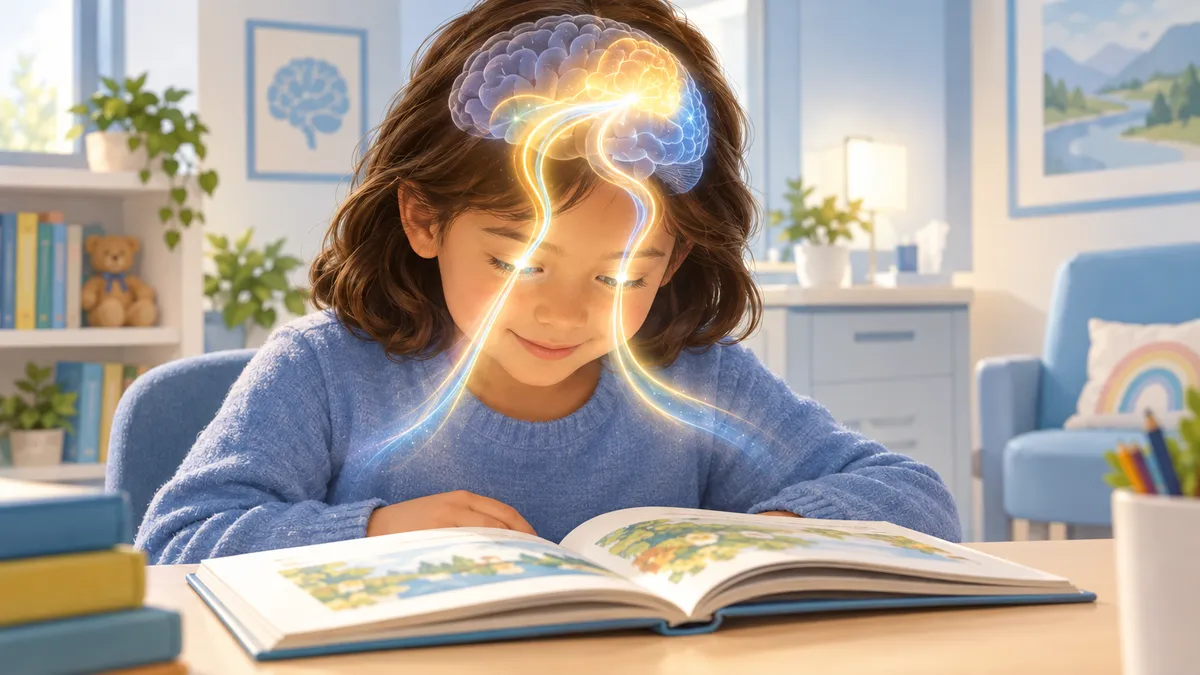
The Brain-Eye Connection: Why Your Child's Vision Is More Than 20/20
The Brain-Eye Connection: Why Your Child's Vision Is More Than 20/20
When your child passes their school vision screening with flying colors, it's natural to feel relieved. "20/20 vision — we're good!" But if your child is still struggling to read, losing their place on the page, avoiding homework, or complaining of headaches after school, you may be left wondering what's really going on.
Here's something many parents are surprised to learn: eyesight and vision are not the same thing. Eyesight tells us how clearly a child can see a letter on a chart from 20 feet away. Vision — true functional vision — is a complex process that involves the brain, the eyes, and the entire visual system working together. And that's where the brain-eye connection becomes one of the most important things to understand when your child is struggling.
What Is the Brain-Eye Connection?
Nearly 80% of learning in the classroom is delivered visually. Yet most of that learning doesn't happen in the eyes — it happens in the brain. The eyes gather information, but it is the brain that interprets, organizes, and gives meaning to what we see.
This remarkable partnership between the brain and the eyes — what we call the brain-eye connection — involves dozens of visual skills working in harmony:
Eye tracking: The ability to smoothly follow a line of text without losing your place.
Eye teaming (binocular vision): Both eyes working together as a coordinated team to create one clear, single image.
Focusing (accommodation): The ability to shift focus quickly and accurately between near and far, and to sustain focus on a page for extended periods.
Visual processing: How the brain interprets, stores, and responds to what the eyes see — including the ability to recognize letters, retain visual sequences, and understand spatial relationships.
Visual memory: Retaining visual information long enough to use it, such as copying from the board or recalling what was just read.
When any part of this system breaks down, a child may be able to see the letters clearly but still struggle to read, write, or pay attention. This is why a standard eye chart test — as helpful as it is — can miss the full picture.
Signs That the Brain-Eye Connection May Be Disrupted
Because the brain-eye connection involves so many interlocking skills, the signs of a visual processing or binocular vision problem can look a lot like other challenges — including attention difficulties, dyslexia, or general learning struggles. This overlap makes it especially important for families to know what to look for.
Your child may be experiencing a vision-related challenge if they:
Skip lines or lose their place frequently while reading
Use a finger to track across the page even after learning to read fluently
Complain of blurry or double vision, especially when reading
Experience frequent headaches or eye strain, particularly during homework
Avoid reading, drawing, or close-up tasks
Have difficulty copying from the board
Read slowly or with poor comprehension despite adequate decoding skills
Seem "smart but struggling" — verbal and creative but falling behind in written work
Have difficulty concentrating on tasks that require sustained visual attention
Cover or close one eye when reading
These experiences can be exhausting and discouraging for children and families alike. If several of these sound familiar, it may be worth exploring whether a visual skills difficulty is contributing — not because vision problems cause all learning challenges, but because undetected visual problems can add a significant and unnecessary layer of difficulty for a child who is already working hard.
Neurovision: When the Brain's Visual System Needs Support
The term neurovision refers to the neurological dimension of how we see — the pathways, processing centers, and brain-based mechanisms that allow us to make sense of visual information. For most children, these pathways develop naturally and efficiently. But for some children, development may be delayed, uneven, or disrupted by factors such as premature birth, early developmental differences, a history of concussion or head injury, or simply the natural variation in how brains grow.
When the brain's visual system needs support, children don't always know how to describe what they experience. They may not realize that other people don't see double when they read, or that text isn't supposed to "swim" on the page. They often assume the difficulty they feel is about intelligence or effort — and that assumption can quietly chip away at their confidence.
This is one of the reasons why a comprehensive developmental vision evaluation is so different from a standard eye exam. A developmental optometrist doesn't just check acuity — they assess how efficiently the entire visual system is functioning, and whether the brain-eye connection is supporting the demands placed on it every day.
How Vision Therapy Supports the Brain-Eye Connection
If a developmental evaluation reveals that a child's visual skills are not functioning as efficiently as they should, vision therapy is often recommended as a structured, evidence-based approach to strengthening those skills.
Vision therapy is not about exercising the eyes in isolation. It is about training the brain and the visual system together — building new neural pathways, improving how the eyes and brain communicate, and helping a child develop the visual stamina and efficiency they need to learn and function comfortably.
A personalized vision therapy program may include activities designed to improve:
Eye teaming and convergence: Helping both eyes work together accurately, which is particularly relevant for children with convergence insufficiency or binocular vision dysfunction (BVD).
Focusing flexibility: Training the focusing system to shift quickly and sustain attention without fatigue.
Eye movement control: Developing smooth, accurate tracking skills for reading and for following moving objects.
Visual processing and cognitive vision: Building the brain-based skills involved in visual memory, discrimination, spatial awareness, and visual-motor integration.
Sessions are typically conducted in-office with a trained vision therapist under the supervision of a developmental optometrist, and are often paired with home practice activities to reinforce progress between visits.
Many families report that after completing a vision therapy program, their child shows improvement in reading comfort, homework stamina, and overall confidence in school. It's important to have realistic expectations — outcomes vary, a comprehensive evaluation determines whether vision therapy is the right fit, and vision therapy is not a replacement for educational support when other learning challenges are also present. But for children whose struggles are rooted in or compounded by visual skills deficits, the results can be genuinely life-changing.
Visual Skills and the Learning Environment
Teachers, school counselors, and learning specialists often play a key role in noticing when a child may have an undetected visual problem. If a student consistently avoids reading, rushes through written work, or seems easily overwhelmed by visually dense tasks, it is worth asking whether a developmental vision evaluation has ever been completed.
At Forest City Vision, we work collaboratively with educators, pediatricians, occupational therapists, and speech-language pathologists to make sure children are seen as a whole — and that no contributing factor, including a visual processing or binocular vision concern, goes unaddressed.
If you are an educator or referral partner reading this, we welcome questions, referral conversations, and professional consultations. Understanding the brain-eye connection is a valuable tool for any professional who works with children who are struggling to learn.
The Good News: The Brain Can Learn
One of the most hopeful aspects of neurovision and vision therapy is what it reveals about the brain's capacity to change. The science of neuroplasticity — the brain's ability to form new connections and adapt — tells us that visual skills are not simply fixed at birth. With the right guidance, appropriate intervention, and consistent practice, many children make meaningful, lasting improvements in how their visual system functions.
This is not about "fixing" a child or suggesting something is wrong with them. It's about giving the brain-eye connection the support it needs to do what it was designed to do — help your child learn, explore, and engage with the world around them.
Take the Next Step: A Comprehensive Vision Evaluation
If your child has passed a vision screening but continues to struggle with reading, learning, attention, or visual comfort, we encourage you to schedule a developmental vision evaluation with our team at Forest City Vision in Cleveland, Ohio.
Our evaluations go far beyond the standard eye chart. We assess the full range of visual skills — including eye teaming, focusing, tracking, and visual processing — to determine whether the brain-eye connection is functioning optimally for your child's needs.
You don't have to wonder. A thorough evaluation can give your family real answers — and a clear path forward.
📞 Contact Forest City Vision today to schedule a developmental vision evaluation, or visit our website to learn more about vision therapy in Cleveland, developmental optometry, and how we support children with learning difficulties, sensory challenges, and more.
Note: This article is intended for educational purposes only and does not constitute medical or optometric advice. Please consult a qualified vision care professional for guidance specific to your child's needs.


