
The Brain-Eye Connection: How Your Child's Vision Shapes the Way They Think, Learn, and Move
The Brain-Eye Connection: How Your Child's Vision Shapes the Way They Think, Learn, and Move
When most parents think about their child's vision, they think about the eye chart on the wall — those rows of letters that get smaller and smaller until your child squints and guesses. But here's something that might surprise you: vision is far more than what your eyes can see. In fact, vision is primarily a brain activity — and the brain-eye connection is one of the most powerful, complex, and overlooked systems in your child's development.
At Forest City Vision, we work with children and families every day who come in frustrated, confused, and sometimes exhausted. Their child's standard eye exam came back normal. Their child can "see" the board at school. And yet, something is still getting in the way of reading, learning, focus, or coordination. Understanding the brain-eye connection often holds the key to answering why.
What Is the Brain-Eye Connection?
Your eyes do not see on their own. The eyes capture light and convert it into signals — but it is the brain that interprets, organizes, and makes meaning out of those signals. In fact, roughly 65% of all neural pathways in the brain are dedicated to vision or vision-related processing. Vision is woven into nearly everything your child does: reading, writing, catching a ball, paying attention in class, navigating a hallway, and even regulating emotion and balance.
This is why we use terms like neurovision and cognitive vision to describe what we do. These aren't just buzzwords — they reflect a deeper understanding that true vision care must address the whole visual system: the eyes themselves and the brain pathways that process what the eyes send up.
When this brain-eye connection is working well, information flows smoothly. When it isn't — whether from developmental delays, a concussion, a learning difference, or simply visual skills that haven't been fully developed — the whole system can struggle in ways that look like attention problems, reading difficulties, coordination issues, or behavioral challenges.
Signs That the Brain-Eye Connection May Need Support
Because so many brain functions rely on visual input, the signs of a strained brain-eye connection can appear in unexpected places. Here are some things families often notice before they ever think to look at vision:
- Skipping lines or losing their place while reading
- Needing to use a finger to track text across the page
- Complaints of headaches, eye strain, or blurry vision after short reading sessions
- Difficulty copying from the board — the information seems to "reset" between glances
- Trouble with reading comprehension even when decoding sounds fine
- Reversing letters or numbers (such as b/d or p/q) beyond the age when this is typical
- Short attention span specifically for near-work tasks like reading or drawing
- Clumsiness, difficulty catching balls, or poor hand-eye coordination
- Covering one eye, tilting the head, or squinting while reading
- Fatigue and frustration that seem disproportionate to the task
None of these signs automatically means a child has a visual processing problem — but together, or in certain combinations, they are worth a closer look from a children's vision specialist who understands developmental optometry.
How the Brain Learns to See: A Developmental Process
Vision is not fully formed at birth. The visual system develops gradually throughout childhood, and certain visual skills — eye teaming, focus flexibility, tracking, visual memory, and spatial awareness — are learned over time through movement, experience, and neurological maturation.
This is good news. It means that in many children, visual skills that haven't developed properly can often be trained, strengthened, and improved. This is the foundation of vision therapy: a structured, evidence-informed program of activities that build the neural pathways that support efficient, comfortable, and accurate visual function.
Think of it like physical therapy — but for the visual system. Just as a child can strengthen a weak ankle through targeted exercises, the brain-eye connection can be retrained and reinforced through carefully guided vision therapy activities. Over time, many children develop more automatic, efficient visual skills that free up mental energy for learning, comprehension, and performance.
Neurovision and the Bigger Picture
At Forest City Vision, our approach to neurovision means we look at vision not as an isolated sense, but as an integrated brain function. This is especially important for children and adults who have experienced:
- Concussion or traumatic brain injury (TBI) — The visual system is one of the most common and most disabling areas affected after a head injury. Blurred vision, double vision, light sensitivity, and difficulty reading are frequent complaints that standard eye exams can miss entirely.
- Stroke or neurological changes — Visual field deficits, eye movement disorders, and processing difficulties can significantly impact daily life and rehabilitation progress.
- Binocular vision dysfunction (BVD) — When the two eyes struggle to work together as a team, the brain is constantly fighting to merge two slightly misaligned images. This invisible effort can cause headaches, anxiety, dizziness, reading avoidance, and even symptoms that mimic ADHD.
- Strabismus and amblyopia — These conditions involve disruptions in how the brain receives and processes images from each eye, and they often require more than patching or glasses to fully address the underlying neural connections.
In all of these situations, treating the eye alone isn't enough. We need to address how the brain is interpreting what the eyes send — and that is where neurovision rehabilitation makes a meaningful difference.
What a Developmental Vision Evaluation Looks At
A standard eye exam checks whether your child can see clearly at a distance, whether a glasses prescription is needed, and whether the eye structures look healthy. These are essential — but they don't evaluate the full range of visual skills that support learning and daily function.
A comprehensive developmental optometry evaluation at Forest City Vision goes deeper. We assess:
- Eye teaming (binocular vision) — Do both eyes aim at the same point accurately and comfortably?
- Convergence — Can the eyes turn inward together for near tasks without fatigue? Convergence insufficiency is one of the most common — and commonly missed — visual problems in school-age children.
- Focusing flexibility (accommodation) — Can the eyes shift focus quickly and accurately between distances?
- Eye tracking — Do the eyes move smoothly and accurately across a line of text?
- Visual processing — How efficiently does the brain recognize, organize, and remember visual information?
- Visual-motor integration — How well does the visual system coordinate with the body, hands, and movement?
When we understand all of these dimensions together, we can build a care plan that is truly personalized — and that addresses the root of what may be getting in the way of your child's success.
Vision Therapy for Brain-Eye Connection: What Families Can Expect
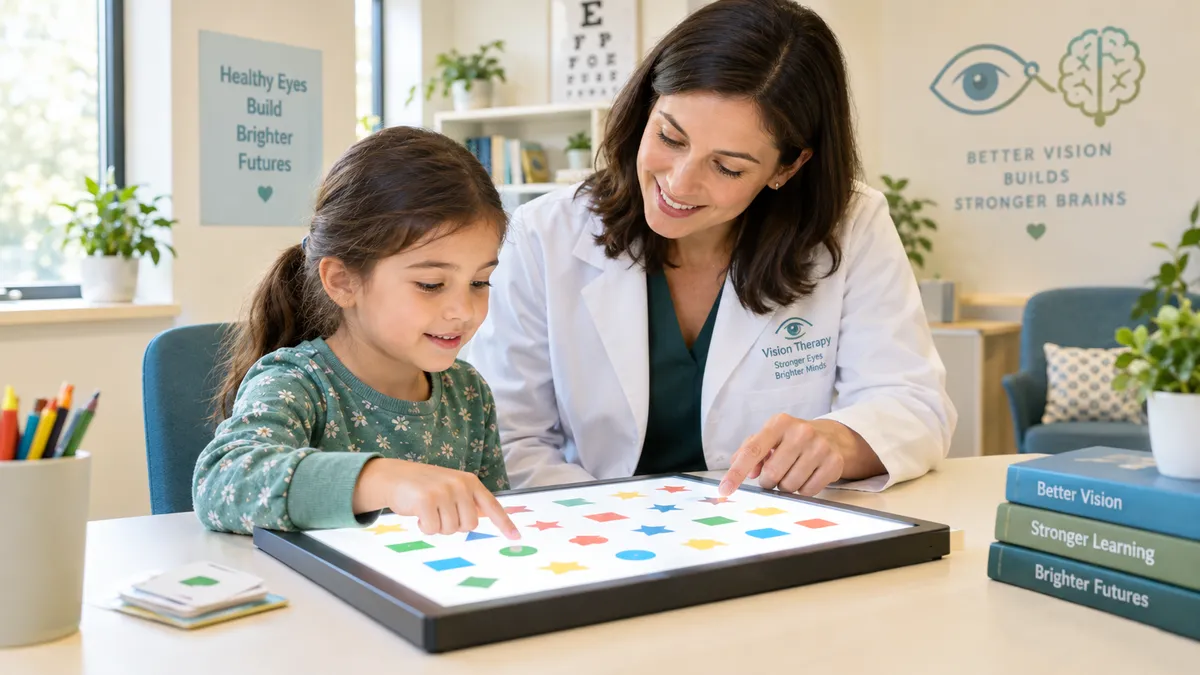
Vision therapy at Forest City Vision is supervised, individualized, and progressive. Sessions are typically held in-office once a week, with home activities to reinforce the skills being built. Programs are tailored to each child's specific visual profile — there is no one-size-fits-all approach.
Activities might include exercises that train the eyes to team more accurately, tasks that build visual memory and processing speed, coordination activities that link the visual system with balance and movement, and technology-assisted training using lenses, prisms, and specialized equipment.
Families often notice changes in areas they didn't expect — not just reading, but also confidence, frustration tolerance, sports performance, and ease of daily tasks. While we never make guarantees, and results vary from child to child, many families who pursue a full course of vision therapy report meaningful improvements in the areas that brought them to us in the first place.
Please note: Vision therapy is not a treatment for ADHD, dyslexia, autism, or learning disabilities. However, when visual skill deficits are present alongside these conditions, addressing those visual problems may reduce some of the strain on a child's attention and learning resources. A thorough evaluation is always the starting point.
Is This Relevant for Your Child?
If your child is working hard but struggling — in school, in sports, in reading, or in managing everyday tasks — it may be worth asking whether the visual system is fully supporting them. Vision problems don't always look like squinting at the board. They often look like a child who avoids books, daydreams in class, loses their place constantly, or simply seems more tired than they should be after school.
A comprehensive vision evaluation is the only way to know for certain. And the earlier visual skill problems are identified, the more opportunity there is to build the brain-eye connection that supports a child's fullest potential.
Take the Next Step with Forest City Vision
At Forest City Vision in Cleveland, Ohio, our team specializes in developmental optometry, vision therapy, neurovision rehabilitation, and sports vision training. We work with children, teens, adults, and athletes — anyone whose visual system could benefit from a deeper level of care.
If you've been searching for answers about your child's reading struggles, attention challenges, or learning difficulties, we invite you to schedule a comprehensive developmental vision evaluation. Our team is here to listen, evaluate, and guide your family with warmth, clarity, and clinical expertise.
📞 Contact Forest City Vision today to learn more or request an appointment. Because when the brain and eyes work together the way they're meant to, everything becomes a little clearer.
Keyword Notes: This post naturally incorporates: brain eye connection, neurovision, cognitive vision, vision therapy, vision therapy explained, vision therapy benefits, binocular vision dysfunction (BVD), convergence insufficiency, visual skills, children's vision specialist, children's eye health, developmental optometry, pediatric vision expert, eye health, reading and learning issues, Strabismus, Amblyopia, Vision Therapy Cleveland, Vision Rehabilitation Cleveland, focus training, eye exercises, sensory kid support.


