
Why Does My Child Reverse Letters and Numbers?
Why Does My Child Reverse Letters and Numbers?
Your child knows the answer is 12—but writes 21.
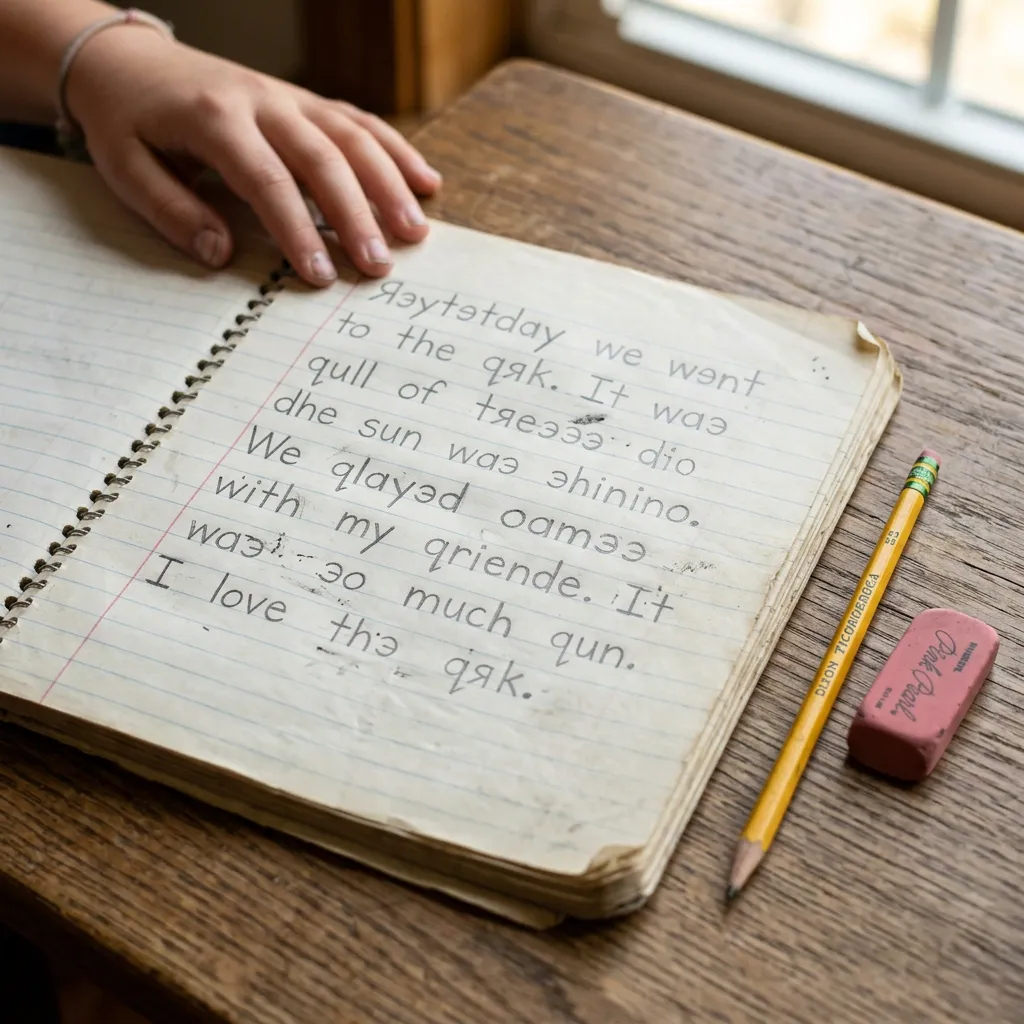
They form a b when they meant to write a d. The next time, the letter is correct. They may copy a word accurately from the board, then reverse the same letter when writing from memory.
For young children, reversals can be a normal part of learning an alphabet in which direction changes meaning. A chair remains a chair when viewed from the other side; a b becomes a different letter when it faces the other way.
Persistent reversals deserve context, not an instant label. They do not diagnose dyslexia or prove that a vision problem is present. When they continue alongside reading, handwriting, spatial, or visual-comfort concerns, however, a broader evaluation can help families understand what the child needs.
Are letter and number reversals normal?
Letter and number reversals are common when children first learn to read and write. Young students are still developing stable memories for symbol direction, letter formation, and left-to-right print conventions. Reversals usually become less frequent with instruction and practice, but development varies and no single mistake establishes a disorder.
Children learn early that objects remain the same when turned or viewed from another angle. Written symbols require a different rule: orientation can change identity.
That makes pairs such as these especially demanding:
b and d
p and q
m and w
6 and 9
12 and 21
A child may recognize a correctly printed letter yet reverse it while writing. Recognition, recall, motor planning, and production are related but distinct tasks.
Research examining the brain’s response to reversed letters supports the idea that sensitivity to letter orientation develops with reading experience. Frequent reversals during early literacy are therefore not surprising.
Parents do not need to correct every mistake with alarm. Calmly model the correct form and provide consistent practice.
Do reversals mean my child has dyslexia?
No. Reversing letters is not a stand-alone sign or diagnostic test for dyslexia. Children with and without dyslexia may make reversals, while many students with dyslexia do not “read backward.” Dyslexia is primarily a language-based learning disability involving difficulties with accurate or fluent word recognition, decoding, and spelling.
A child should be evaluated for dyslexia based on the broader reading and language pattern—not simply whether a b faces the wrong direction.
Relevant concerns may include:
Difficulty connecting letters with sounds
Trouble separating or combining speech sounds
Slow or inaccurate word reading
Weak spelling despite instruction
Difficulty reading unfamiliar words
A family history of dyslexia
Reading performance below expectations
Limited progress with evidence-based instruction
Formal dyslexia assessment commonly examines phonological processing, language, word reading, spelling, fluency, and the child’s response to instruction.
Vision therapy does not treat or cure dyslexia. A student with dyslexia needs evidence-based, explicit language and literacy instruction.
A separate visual dysfunction can coexist with dyslexia, ADHD, autism, sensory processing disorder, or another learning disability. When that happens, the visual issue may create an additional barrier to comfort or performance, but it is not the cause of the child’s entire learning profile.
Could vision contribute to persistent reversals?
Vision is not considered the primary cause of typical letter reversals or dyslexia. However, difficulties involving eye movements, focusing, binocular coordination, visual-spatial organization, visual memory, or visual-motor integration may coexist with reversal errors and other school symptoms. Appropriate testing is needed before connecting a child’s mistakes to vision.
Writing a letter correctly requires more than seeing it clearly. A student must:
Notice the symbol’s defining features.
Remember its direction and sequence.
Retrieve the correct form.
Plan the hand movement.
Monitor the result while writing.
These processes illustrate cognitive vision—how visual information is selected, remembered, organized, and used to guide action. They also involve language, attention, instruction, and motor development.
Reversals alone cannot tell us which part of the process is difficult. A child might reverse a letter because its directional memory is not yet stable, because letter formation is not automatic, or because attention is divided between spelling and handwriting.
Another student may have broader visual skills concerns, such as losing place, misaligning math problems, struggling to copy, or becoming uncomfortable during close work.
The pattern matters more than the isolated error.
Can a child reverse letters despite having 20/20 vision?
Yes. Twenty-twenty visual acuity measures how clearly a child identifies a target at a specified distance. It does not fully assess focusing stamina, eye teaming, tracking, visual-spatial processing, visual memory, or coordination between visual information and the hand. Clear eyesight and efficient visual performance are not identical.
Comprehensive eye-health care evaluates visual acuity, prescription needs, eye alignment, and the health of the eyes. Every child needs this foundation.
A functional or developmental vision assessment addresses additional questions. Can the child maintain clear and comfortable near vision? Do the eyes move and work together efficiently? Can visual information be organized and used during reading, copying, and handwriting?
These evaluations complement one another.
A child may have healthy eyes and no functional visual disorder but still need literacy, handwriting, occupational therapy, or educational support. Conversely, passing a distance vision screening does not rule out every problem that can affect sustained schoolwork.
What can parents and teachers notice?
Look beyond whether a reversal occurred. Notice the child’s age and instructional experience, how often mistakes happen, whether the child can recognize and correct them, and whether reversals appear with other reading, writing, spatial, or visual symptoms. A consistent pattern gives the evaluation team more useful information than one worksheet.
Helpful observations include:
Which letters or numbers are reversed
Whether mistakes occur when copying, writing from memory, or both
Whether the child notices an error when prompted
Reversing individual symbols versus reversing their order
Confusing left and right during other tasks
Poor spacing or inconsistent letter placement
Difficulty keeping numbers aligned in math
Slow, effortful, or painful handwriting
Losing place or skipping lines while reading
Headaches, blur, double vision, or eye fatigue
Closing one eye or moving unusually close to the page
Performance that declines with fatigue
Progress after explicit letter-formation instruction
Save a few dated work samples rather than repeatedly testing the child. They can help a teacher, occupational therapist, reading specialist, psychologist, speech-language pathologist, or optometrist see how the pattern changes over time.
Which evaluation should come first?
The appropriate evaluation depends on the complete symptom pattern. Persistent reversals with decoding or spelling difficulty warrant educational and language-based assessment. Handwriting and fine-motor concerns may warrant occupational therapy input. Visual discomfort, tracking concerns, or related functional symptoms support comprehensive eye care and possibly a Developmental Vision Evaluation.
Families do not need to choose one explanation before gathering information.
A collaborative assessment may include:
Review of classroom instruction and progress
Reading and spelling screening
Phonological and language testing
Handwriting and fine-motor assessment
Comprehensive ocular-health examination
Functional vision testing
Psychological or neuropsychological evaluation when indicated
Through developmental optometry, testing may examine focusing, binocular coordination, eye movements, visual-spatial abilities, visual memory, and visual-motor integration when clinically appropriate.
The purpose is not to prove that reversals are visual. It is to identify or rule out measurable visual factors while respecting the roles of language, instruction, attention, and motor development.
Can vision therapy stop reversals?
Vision therapy should not be prescribed solely because a child reverses letters or numbers. It may be appropriate when an examination identifies a specific, treatable functional vision disorder. Treatment targets the diagnosed visual difficulty; it does not cure dyslexia or guarantee that reversals, reading performance, handwriting, or grades will improve.
Optometric vision therapy is an individualized, doctor-supervised program—not a generic list of eye exercises.
When prescribed, clinical activities may address measured difficulties involving eye teaming, focusing, eye movements, spatial awareness, visual memory, or visual-motor integration. The optometrist monitors performance and adjusts the task’s timing, visual complexity, lenses, movement, and accuracy demands.
Some children need glasses, classroom supports, structured literacy instruction, occupational therapy, or additional practice instead. Others need coordinated care involving several professionals.
For families searching for Vision Therapy Cleveland, the first step should be an evaluation, not an assumption that therapy is necessary.
For students in Beachwood, Cleveland, and across Northeast Ohio, the goal is clarity: Is the child showing a normal developmental pattern, a literacy or motor concern, a visual difficulty, or a combination?
That is how we move from frustration to clarity—one visual skill at a time.
FAQs
At what age should letter reversals become concerning?
Reversals are common during early literacy development. Consider discussing persistent or frequent reversals with the child’s teacher when they continue despite appropriate instruction, especially if they occur with reading, spelling, handwriting, or visual symptoms.
Does confusing b and d mean my child has dyslexia?
No. A b–d reversal alone does not diagnose dyslexia. Dyslexia is identified through a broader assessment of language, phonological processing, decoding, spelling, reading accuracy, and fluency.
Can a child have relevant visual difficulties with 20/20 eyesight?
Yes. Visual acuity measures clarity but does not fully assess eye teaming, focusing, tracking, visual-spatial processing, visual memory, or visual-motor coordination.
Will vision therapy correct letter and number reversals?
Not necessarily. Vision therapy is appropriate only when testing identifies a relevant functional visual disorder. It should not be presented as a cure for dyslexia or a guaranteed way to eliminate reversals.
Call to action
If persistent reversals occur alongside headaches, visual fatigue, loss of place, copying difficulty, poor spatial organization, or other unexplained school concerns, Forest City Vision can help determine whether a measurable visual factor is contributing.
Schedule a Developmental Vision Evaluation with Dr. Zach Weinberg in Beachwood, Ohio.
Call: (216) 468-8020
Learn more:visiontherapycleveland.com


